Vāmana Dvādaśī: The Appearance of Lord Vāmanadeva
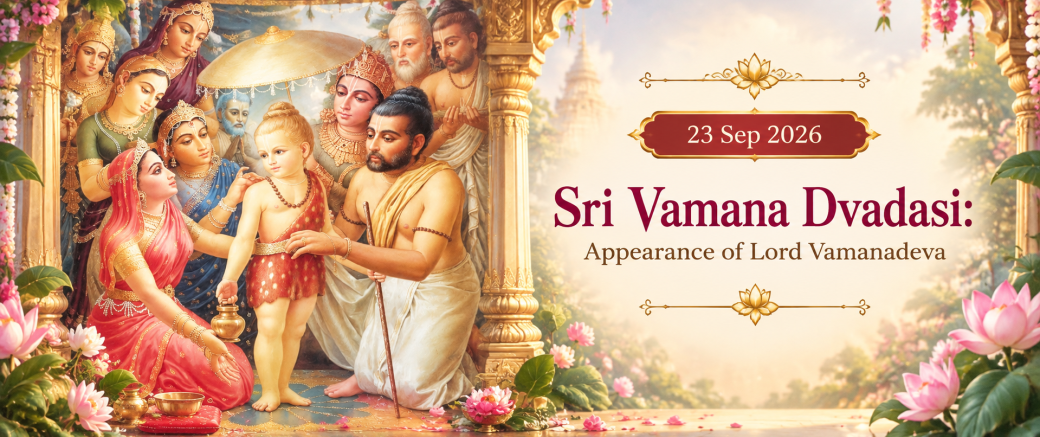
Vāmana Dvādaśī is the appearance day of Lord Vāmanadeva, who appeared in the form of a small brāhmaṇa boy and entered into the remarkable pastime of accepting charity from Mahārāja Bali, the grandson of Prahlāda Mahārāja.
Bali Mahārāja, who was the grandson of Prahlāda Mahārāja and a powerful king of the Daitya dynasty, worshipped Lord Viṣṇu. Through his strength and determination, he was able to defeat Indra and became the ruler of the entire universe. Seeing that the demigods had lost their position, Aditi, the mother of the demigods, together with the devas, approached Lord Viṣṇu and offered their prayers and obeisances. Lord Viṣṇu agreed to appear as Vāmanadeva.
The Lord then appeared as a brāhmaṇa in a dwarf-like form, and He became known as Vāmanadeva. He eventually went to the sacrificial arena of King Bali, accompanied by Indra, and approached the king to ask for charity.
When Bali Mahārāja saw the young brāhmaṇa, he welcomed Him and offered Him the opportunity to ask for whatever He desired. Vāmanadeva simply requested three steps of land.
Bali Mahārāja was surprised. He said, in effect, “Why only three steps? I can give You an entire planet. I can give You a wonderful wife, wealth, jewels, or anything else You desire!”
But Vāmanadeva remained satisfied with His simple request. He explained that if one cannot become satisfied with three steps of land, then one will not necessarily become satisfied even by possessing much more.
Bali Mahārāja was ready to fulfill the request, but his spiritual master, Śukrācārya, understood that this was Lord Viṣṇu Himself appearing as Vāmanadeva. He therefore warned Bali Mahārāja not to give the Lord what He had requested.
Śukrācārya explained various circumstances in which a person could withdraw from a promise without incurring fault—for example, in certain situations involving danger, marriage arrangements, or the protection of one's life. He tried to convince Bali Mahārāja that he did not have to fulfill his promise.
But Bali Mahārāja had already made his decision.
He thought, “If He is Viṣṇu, then I worship Viṣṇu. If the Lord Himself has come before me and asked for this, then I will give Him exactly what He has requested.”
Śukrācārya became angry and warned Bali Mahārāja that if he continued with the offering, he would lose everything. Yet Bali Mahārāja remained determined.
At that moment, Vāmanadeva prepared to receive the water that would formally confirm Bali Mahārāja's gift. Śukrācārya, using his mystic power, entered the spout of the water pot in the form of a small creature in an attempt to prevent the water from flowing.
Vāmanadeva then used a small blade of straw to clear the opening. Śukrācārya was struck in the process and became blind in one eye.
The obstruction was removed, and Bali Mahārāja poured the water into Vāmanadeva's hand, formally confirming his promise.
And then the astonishing transformation took place.
The small form of Vāmanadeva began to expand—bigger and bigger and bigger—until He became Trivikrama, the gigantic universal form of the Lord.
With His first step, He covered the earthly planetary system, Bhū-loka. Then His body continued expanding until He covered the higher planetary systems—Bhūḥ, Bhuvaḥ and Svaḥ, extending through Maharloka, Janaloka, Tapoloka and Satyaloka. His form encompassed the entire universe.
His foot reached the covering of the universe, and His toenail pierced that covering, allowing the waters of the Ganges to enter.
Then Trivikrama turned to Bali Mahārāja and asked, “Where shall I place My third step?”
Bali Mahārāja had nothing left to give. He had offered everything he possessed.
So he bowed down and offered his own head.
“Place Your lotus foot upon my head.”
And Vāmanadeva placed His lotus foot upon the head of Bali Mahārāja.
What appeared to be the loss of everything became the greatest blessing for Bali Mahārāja. The Lord then told him that he would go to Sutala, where he would reside, and the Lord Himself would remain there as his doorkeeper and protector, ensuring that no one would attack him.
This beautiful pastime also reminds us of the importance of Ekādaśī and Dvādaśī. The fast is observed on the Ekādaśī preceding Vāmana Dvādaśī, since Dvādaśī is the appearance day of Vāmanadeva and is not observed as a fasting day in the same way. On Ekādaśī, devotees traditionally refrain from cereals, grains and pulses, and those who are able may observe a more complete fast and remain awake throughout the night in remembrance of the Lord.
This is a great Ekādaśī, and its observance is understood to destroy previous karmic reactions and bring one closer to the spiritual destination.
The story of Bali Mahārāja is especially inspiring because he was a gṛhastha, just as Prahlāda Mahārāja was, and yet both demonstrated profound devotion. Bali Mahārāja was born in a family of demons, but his birth did not prevent him from becoming a great devotee. His life shows that devotion to the Lord is not restricted by one's family background. When one sincerely practices bhakti-yoga and chants the Hare Kṛṣṇa mahā-mantra, spiritual success is possible.
As His Holiness Jayapatākā Swami has encouraged:
Please chant Hare Kṛṣṇa.
Vāmana Dvādaśī in Māyāpur
In Śrī Māyāpur, the celebration of Vāmana Dvādaśī carries a particularly sweet and intimate mood. Devotees make an effort to recreate the auspicious atmosphere of this pastime through loving service.
One of the special sights during the celebration is a young little Vaiṣṇava dressed as Lord Vāmanadeva. Devotees then lovingly offer personal seva to Vāmanadeva, including washing His feet, offering massage, feeding Him and performing many other forms of service.
There is a special sweetness in witnessing this. A child dressed as Vāmanadeva becomes the focus of loving service, and devotees have the opportunity to participate in a simple and heartfelt recreation of the mood surrounding the Lord's appearance.
In this way, Vāmana Dvādaśī in Māyāpur is not simply an occasion to hear the story of Vāmanadeva and Bali Mahārāja. It becomes an opportunity to remember the Lord's appearance, to glorify His wonderful activities, and to experience the joy of serving Him together.
On this auspicious Vāmana Dvādaśī, let us remember the surrender of Bali Mahārāja, the mercy of Lord Vāmanadeva, and the power of sincere devotional service.
Hare Kṛṣṇa!
Posted 23 hours ago